
Showing posts with label Boeing. Show all posts

Monday, October 1, 2012

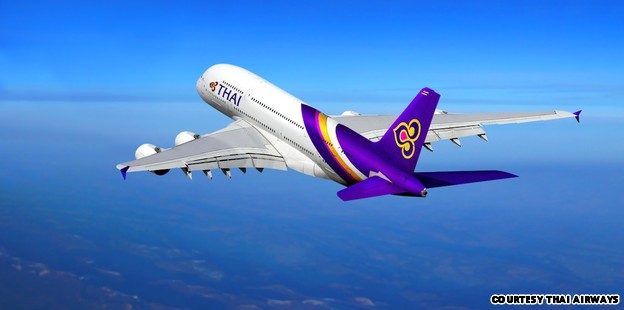
New sky giant: Thai Airways receives its first A380 Superjumbo


Thai Airways received its first Airbus A380 Superjumbo last week, boosting efforts to compete with Singapore Airlines and Emirates for lucrative corporate travellers.

The carrier's planned fleet of six A380s and new Boeing 777-300ERs will help it raise the percentage of seats filled in premium cabins across its network to more than 70 per cent from about 60 per cent, Acting-President Chokchai Panyayong said in a interview in Bangkok. He didn't give a timeframe for the goal.

Load factors in first and business class are "a little bit low," he said. "With improvements in the product and services we can increase that."
Thai's 507-seat A380s and new regional unit Thai Smile will lead a push to win more business traffic as low-cost airlines lure leisure flyers. Budget airlines eventually may boost their share of regional travel to as much as 35 per cent from 20 per cent, Chokchai said.

Tuesday, March 27, 2012

Boeing, Airbus watchers fear production rates headed too high

Boeing and Airbus are ratcheting up production of narrowbody aircraft to excessive and unsustainable rates, according to many industry insiders at an aircraft conference here.
Boeing decidedly doesn't think so, and is determined to build jets at full speed ahead.
The pessimistic view is held by many airplane buyers at the annual conference of the International Society of Aircraft Traders, which opened Monday.
"We are in a bubble," Adam Pilarski, a respected industry analyst with consulting firm Avitas, told his audience of airplane lessors and financiers.
He said the announced production rates of 42 single-aisle jets per month from each plane-maker by 2014 would result in 5,000 more narrowbody jets being built over the next 20 years than the two companies' own forecasts predict will be needed.
But he said in a later interview that Boeing's plans to accelerate production make strategic sense. " "You still want to enjoy it while it lasts. Why not? Eventually the bubble bursts — too bad. If I were Boeing or Airbus I'd do exactly the same thing."

Friday, March 23, 2012

Airbus, Boeing, Embraer collaborate on aviation biofuel development


Airbus, Boeing and Embraer today signed a Memorandum of Understanding (MoU) to work together on the development of drop-in, affordable aviation biofuels. The three leading airframe manufacturers agreed to seek collaborative opportunities to speak in unity to government, biofuel producers and other key stakeholders to support, promote and accelerate the availability of sustainable new jet fuel sources.
Airbus President and CEO Tom Enders, Boeing Commercial Airplanes President and CEO Jim Albaugh, and Embraer Commercial Aviation President Paulo César Silva, signed the agreement at the Air Transport Action Group (ATAG) Aviation and Environment Summit in Geneva.
“We’ve achieved a lot in the last ten years in reducing our industry’s CO2 footprint - a 45 percent traffic growth with only three percent more fuel consumption,” said Tom Enders. The production and use of sustainable quantities of aviation biofuels is key to meeting our industry's ambitious CO2 reduction targets and we are helping to do this through R+T, our expanding network of worldwide value chains and supporting the EU commission towards its target of four per cent of biofuel for aviation by 2020."

Saturday, March 17, 2012

Current Aviation Market Outlook 2011 - 2030 (Boeing)


Air travel market recovering

Passenger air traffic rose 8 percent in 2010, after declining about 2 percent in 2009. The persistent resilience of air travel is expected to sustain 6 percent growth in 2011 and keep the growth rate at or above the historical trend through the middle of the decade.
Although volatile fuel costs, political upheaval in the Middle East and North Africa, and unresolved government debt in many industrialized economies create risk of a renewed downturn, commercial aviation has weathered such shocks to the system in the past. Recovery has followed each event as the industry reliably returned to its long-term growth rate of approximately 5 percent per year. We see that same resilience come into play as airlines have skillfully managed capacity to maintain profitability in face of the variety of challenges that have beset the industry as the world economy emerges from the global recession.


Purpose of the forecast

The Current Market Outlook is our long-term forecast of air traffic volumes and airplane demand. Each year's forecast starts from a blank computer screen, so we can factor the current business conditions and developments into our analysis of the long-term drivers of air travel.
The forecast details demand for passenger and freighter airplanes, both for fleet growth and for replacement of airplanes that retire during the forecast period.
We have shared the forecast with the public since 1964 to help airlines, suppliers, and the financial community make informed decisions.


The shape of the market

The long-range forecast for 2011 anticipates delivery of 33,500 new airplanes over the next 20 years, valued at more than $4.0 trillion. Looking back at our forecasts over the past 10 years reveals that our projections for long-term market growth tend to be conservative, compared to actual industry performance.
We have been admirably accurate, however, on the crucial forecast of the market share that each airplane size category will capture. Single-aisle airplanes account for the majority of deliveries over the next 20 years-70 percent of the airplanes and 48 percent of the value. Rapidly expanding air service within China and other emerging economies and the spread of low-cost carrier (LCC) business models throughout the world drive this market segment. The twin-aisle market, which includes efficient long-range airplanes such as the Boeing 787 and 777, is the fastest growing segment of the market, accounting for 22 percent of the delivery units and 43 percent of the delivery dollars. High fuel costs are compelling airlines to accelerate replacement of older airplanes. In addition, the increased capabilities of the latest long-range, twin-aisle airplanes create opportunities for operators to take advantage of the ongoing liberalization of air transport markets to open new nonstop routes.

Saturday, March 3, 2012

Boeing finds FMS training for pilots flawed


Pilots take much longer than assumed by manufacturers and airlines to become comfortable with operating a new flight management system, according to a Boeing study of airline pilot perceptions of training and its effectiveness.
The study, presented by Boeing's lead research scientist Dr Barbara Holder at the Flight Safety Foundation's European Aviation Seminar in Dublin today, found that 63% of pilots feel they struggle to manage the FMS on a new aircraft type until they have been operating it on the line for between three and six months. More than 40% of pilots say that most of the FMS training they get is done while flying the line. The implication is that the FMS training the pilots receive on their type rating work-up is inadequate.
Holder noted that there is no standardisation among aircraft manufacturers, avionics manufacturers and airlines in how FMS training should be delivered, or the regulators. Holder found that the manufacturers make assumptions that the pilots will have a certain - unspecified - degree of prior knowledge, which evidence does not appear to support. Comment generated by Holder's presentation at the seminar included the information that manufacturers provide no FMS training guidance at all for an operator trying to transition pilots from a second-generation aircraft like a Boeing 737-200 on to a 737NG. Holder concluded there is a need for FMS training to be radically reappraised.
Source: Flight Global

Sunday, February 26, 2012

NTSB calls for safety upgrades for Boeing 737 cabin, pilot seats


Passengers and pilots in a series of survivable Boeing 737 crashes may have been injured by approved cabin overhead systems or crew seat belt restraints designed or tested to inadequate levels for an actual crash.
A series of new recommendations from the US National Transportation Safety Board (NTSB) call on the US Federal Aviation Administration to modify the design and test requirements related to passenger service units (PSUs) in Next Generation Boeing 737 family aircraft, and to analyse aircraft from other manufacturers for similar problems.
PSUs, which are mounted above each seat on the underside of the overhead bins, include supplemental oxygen generators, oxygen masks and ventilation air vents, and typically weigh about 5.7kg (12.5lb).

Tuesday, February 14, 2012

Boeing studies ultra long-range 777-8LX concept


The new 777 variant would be capable of a range of 16,330 miles
holding a maximum of 195,270 liters or 51,585 gallons.

Boeing is exploring an ultra long-range replacement of the 777-200LR, conceptually dubbed the 777-8LX.
Likely to be the last of three members of a conceptual 777X family, the -8LX could potentially have a service entry in the 2020s, providing a mission range of 17,550km (9,480nm), industry sources tell Flightglobal, which is 85nm longer than the 17,395km (9,395nm) offered by the 777-200LR.
The reduced fuel burn per seat for the -8LX is estimated to be a 14% to 16% improvement over the 777-300ER, and the extended range may, for the first time, open the prospect of profitably operating flights between Sydney and London without a "kangaroo" stop in Southeast Asia.
Today's ultra long-range 777-200LR and the Airbus A340-500, which is no longer in production, have served in mostly niche roles for carriers requiring long-range capacity on hot and high and extended missions.

Monday, February 13, 2012

Asia's Aviation Boom Comes With Rising Competition

While Europe's debt crisis and global economic uncertainty are threatening airline profitability in the West, in Asia airlines are experiencing relatively strong growth.

According to forecasts from the International Air Transport Association (IATA), carriers based in Asia Pacific will make profits of $2.1 billion in 2012. That's 60 percent of the total profits of $3.5 billion predicted for the global airline industry.
But below the surface, there's a growing risk to the health of the region's airline sector from increased competition. Airlines in Asia are adding capacity at such a rapid clip on international routes that industry watchers are growing alarmed.
Airline CEOs will be meeting on the sidelines of the Singapore Airshow this week to discuss the challenges facing the sector.

Saturday, February 11, 2012

Airbus reports 2011 aircraft orders and deliveries

 Airbus beat Boeing in 2011, delivering 534 commercial aircraft and booking 1,419 net orders. Most of the orders were for the A320neo (new engine option).


Airbus (Toulouse, France) announced on Jan. 17 that it delivered 534 commercial aircraft to 88 customers (10 new) and booked 1,419 net orders in 2011, making it the most successful year in the company’s history, and the 10th in a row with a production increase.
The 534 deliveries beat the previous record set in 2010 by 24 aircraft. Deliveries include a new record for 421 single-aisle aircraft (401 in 2010), 87 A330 Family (87 in 2010) and 26 A380s (18 in 2010). December was a record month for the A380, with four deliveries in a single month. Airbus Military also delivered a record number of 29 aircraft (20 light and medium military and transport aircraft — C212, CN235 and C295, three P-3 conversion aircraft and 6 A330 MRTTs).

Friday, February 10, 2012